Triggers That Feel
Better
Smoother
Faster
Precision Triggers Built Right Here in the USA

Not long ago, the idea of producing firearm components with a 3D printer sounded like something out of a science fiction movie. Today, it’s a real technology that’s raising some interesting questions throughout the firearms industry.
And I’m not just talking about people experimenting with plastic parts in their garages.
We’re talking about a manufacturing technology that has become part of a much larger conversation involving firearm design, federal regulations, personal firearm ownership, and the future of manufacturing.
If you’ve followed firearms news over the past several years, you’ve probably heard terms like 3D-printed guns, ghost guns, and privately made firearms.
Those terms often get thrown around as though they mean the same thing. They don’t.
So let’s look at what 3D-printed firearms actually are, how the technology works, what the law says, and what all of this could mean for the firearms industry.
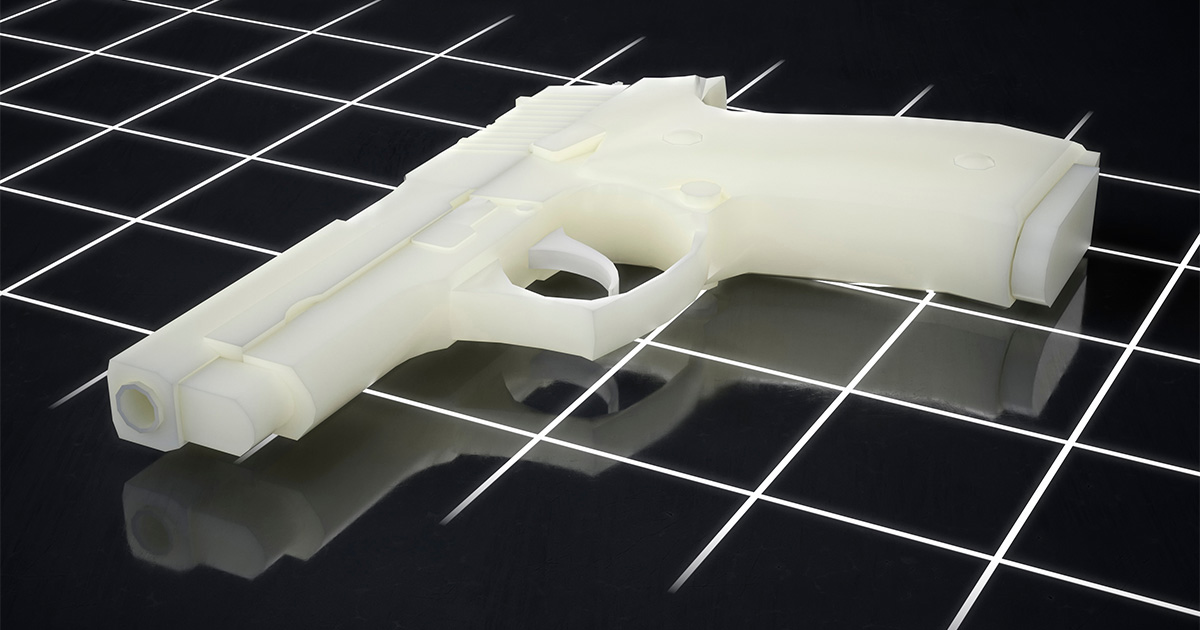
A 3D-printed firearm is a firearm that has one or more components produced using a process called additive manufacturing.
Traditional manufacturing methods often involve cutting, machining, or shaping material into a finished component.
Additive manufacturing works differently. It creates an object from a digital design by adding material in successive layers.
Depending on the equipment and process, additive manufacturing can involve different materials, including polymers and metals.
But here’s an important distinction: A 3D-printed firearm doesn’t necessarily mean every component was printed.
Some firearms incorporate printed components alongside conventionally manufactured parts.
That distinction matters because the term 3D-printed gun can give people the impression that an entire firearm comes straight out of a desktop printer, ready to use.
The reality is more complicated.
The ATF recognizes 3D printing as one of the methods individuals may use to produce privately made firearms. Federal firearm laws still apply regardless of the manufacturing method.
One of the earliest widely publicized examples appeared in 2013.
That year, a firearm design known as the Liberator attracted national attention after digital plans for a largely plastic pistol were distributed online.
The development raised questions about firearm detectability, digital design files, and how existing laws applied to a manufacturing process that was becoming more accessible.
The Congressional Research Service has documented the Liberator’s introduction and the legal concerns surrounding 3D-printed firearms.
The significance wasn’t simply that someone had produced a firearm using a printer.
It was that firearm-related designs could now be distributed digitally, introducing legal and regulatory questions that traditional manufacturing hadn’t presented in quite the same way.
More than a decade later, those questions remain part of the discussion.
This is probably one of the biggest misunderstandings surrounding the subject.
You’ll often see the terms 3D-printed firearm and ghost gun used interchangeably in news coverage.
But they describe different things.
A 3D-printed firearm is identified by the manufacturing method used to produce one or more components.
The term ghost gun is commonly used to describe an unserialized, privately made firearm.
The ATF uses the more specific term Privately Made Firearm (PMF).
Under the federal regulatory definition, a PMF is a firearm, including a frame or receiver, produced by someone other than a licensed manufacturer without a serial number applied by a licensed manufacturer when it was produced.
A privately made firearm might involve 3D printing, but it could also be produced through other manufacturing methods.
In other words, not every privately made firearm is 3D-printed.
And a firearm containing a 3D-printed component isn’t automatically an unserialized privately made firearm.
Understanding that difference makes it much easier to follow the legal discussion without confusing two separate issues.
The answer isn’t a simple yes or no.
Under federal law, eligible individuals may generally manufacture certain firearms for their own personal use without holding a federal firearms license.
The ATF specifically acknowledges that privately made firearms may be produced using 3D printing or other manufacturing methods, provided applicable federal requirements are satisfied.
However, that doesn’t mean every firearm design, manufacturing activity, or possession situation is legal.
Restrictions can depend on the type of firearm, the person involved, the purpose of manufacture, and the laws of the state or locality.
Certain firearms and devices are subject to additional federal restrictions under the National Firearms Act and other laws.
Manufacturing firearms as a business also raises different licensing requirements than producing an eligible firearm for personal use.
The important point is that 3D printing doesn’t create an exemption from firearm laws.
The same basic legal questions surrounding firearm classification, possession, manufacturing, and distribution still matter.
Anyone considering activities involving privately made firearms should consult current federal, state, and local requirements rather than relying on general information found online.
This is another issue that received attention when 3D-printed firearm designs first became widely known.
Federal law addresses undetectable firearms through the Undetectable Firearms Act.
The law establishes restrictions relating to firearms that fail specified detectability requirements.
These restrictions are particularly relevant when discussing firearms made primarily from nonmetallic materials.
The Congressional Research Service has examined the relationship between 3D-printed firearms and the Undetectable Firearms Act, including concerns raised by the Liberator design.
It’s worth remembering that the law concerns specific detectability requirements, not simply whether a firearm contains plastic.
A firearm isn’t automatically unlawful because it uses polymer components.
After all, polymer-framed firearms have been part of the commercial firearms industry for decades.
The legal question involves the applicable statutory requirements and the firearm’s actual characteristics.
One of the most significant recent legal developments came on March 26, 2025.
That’s when the U.S. Supreme Court issued its decision in Bondi v. VanDerStok.
The case concerned federal regulations addressing certain firearm parts kits and partially completed frames or receivers.
The central question involved whether the Bureau of Alcohol, Tobacco, Firearms and Explosives had acted within its statutory authority when interpreting federal firearm definitions.
The Supreme Court upheld the challenged rule against that facial challenge, concluding that the Gun Control Act permits regulation of at least some weapon parts kits and unfinished frames or receivers covered by the rule.
But there’s an important distinction here.
The decision did not establish a nationwide ban on 3D-printed firearms.
It addressed how federal firearm definitions apply to certain products and configurations.
That makes the case relevant to the broader conversation about privately made firearms, even though the ruling wasn’t specifically about whether someone could use a 3D printer.
For gun owners following the issue, it’s a reminder that firearm regulations can involve complicated questions about how existing laws apply to new products and manufacturing methods.

There’s a statistic that frequently comes up in discussions about privately made firearms.
According to the ATF, approximately 45,240 suspected privately made firearms were reported as recovered by law enforcement from potential crime scenes between 2016 and 2021.
Those reports included 692 homicides or attempted homicides.
That’s a substantial number, but it’s important to understand exactly what it represents.
These figures concern suspected privately made firearms recovered and reported to the ATF.
They do not tell us how many of those firearms were 3D-printed.
They also don’t establish the total number of privately made firearms owned in the United States.
The distinction matters because statistics can quickly become misleading when people use them to support claims they weren’t designed to measure.
The ATF has identified tracing difficulties associated with unserialized privately made firearms, which helps explain why these firearms have received significant attention from law enforcement and policymakers.
This is where I think the discussion becomes especially interesting.
3D printing isn’t just a firearm issue. It’s part of a much broader manufacturing technology known as additive manufacturing.
The ability to produce physical objects from digital designs has applications across numerous industries.
In the firearms world, the technology raises questions about how components are designed, how prototypes are developed, and how different manufacturing methods might be used in the future.
But we need to separate the possibilities from what’s actually established.
The existence of 3D-printed firearms doesn’t mean traditional machining, forging, casting, or other established manufacturing methods are becoming obsolete.
Nor does it mean a printed component automatically offers the same mechanical properties as a conventionally manufactured one.
Manufacturing methods have to be evaluated based on the intended application, material properties, engineering requirements, and quality-control processes.
That’s particularly important with firearms, where components can be exposed to substantial mechanical stresses.
I wouldn’t assume that a component is suitable for firearm use simply because it can be produced with a printer.
The bigger industry question is how additive manufacturing might complement established manufacturing processes, rather than whether it will replace them entirely.
Any firearm component needs to be appropriate for the mechanical demands of its intended application.
With additive manufacturing, factors such as the material, manufacturing process, and finished component’s properties can affect performance.
Not every 3D-printing process produces the same results, and not every printable material is appropriate for every application.
That’s why the distinction between a visually complete component and a properly engineered component is important.
A part can look finished without necessarily having the material properties or dimensional characteristics required for its intended function.
For firearm owners, the safest approach is to rely on components with documented specifications and appropriate testing for their intended use.
A firearm’s appearance alone cannot establish whether it is safe or reliable.
I think it’s reasonable to say the technology has already changed the conversation.
It has introduced new questions about digital designs, private manufacturing, firearm classification, and the relationship between technology and regulation.
We’ve also seen those questions reach federal agencies, Congress, and the Supreme Court.
What we can’t say with certainty is exactly how much of the firearms industry will eventually adopt additive manufacturing or which applications will become commercially important.
Those are developments worth watching rather than predicting.
Traditional manufacturing remains an important part of firearm production, and any new process still has to meet the engineering demands of the finished product.
The interesting part is that the conversation is no longer limited to whether a firearm can be 3D-printed.
It’s now about how the technology fits into manufacturing, ownership, safety, and the law.
And that’s a much bigger discussion.
Technology has always played a role in how firearms are designed and manufactured.
Some developments become industry standards. Others remain specialized applications or generate more questions than answers.
3D printing is particularly interesting because it brings manufacturing technology, firearm ownership, and government regulation into the same conversation.
I’m interested in hearing what other shooters think.
Do you see 3D printing becoming a meaningful part of mainstream firearm manufacturing, or do you think traditional manufacturing methods will continue to dominate?
Share your thoughts in the comments. I’m interested in seeing where the RAMM Tactical community stands on this one.
Karl
The Trigger Guy