
Triggers That Feel
Better
Smoother
Faster
Precision Triggers Built Right Here in the USA

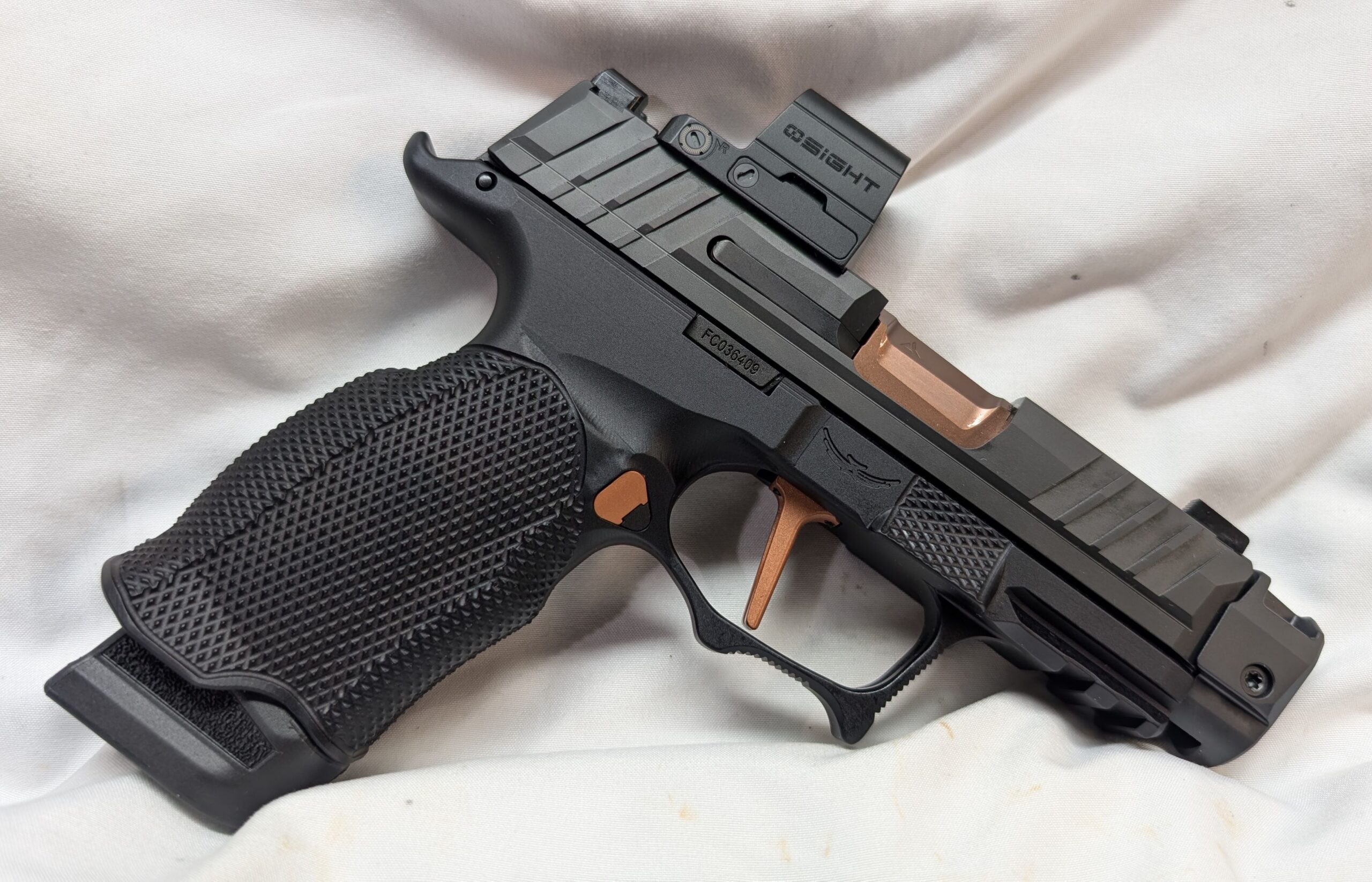
If you could walk into a gun store in 1976 and then walk into one today, you’d notice some pretty big differences.
Back then, steel and aluminum-framed handguns were common, revolvers were still widely used, and most shooters relied on traditional iron sights.
Today, polymer-framed pistols, electronic optics, modular firearm platforms, and advanced manufacturing methods are familiar parts of the firearms industry.
But here’s what’s interesting.
Some of the technology we consider modern today was already being developed 50 years ago.
And in a few cases, even earlier.
The basic principles behind how many firearms operate haven’t changed all that much. A cartridge still needs to be chambered, fired, and extracted. A semiautomatic firearm still needs a mechanism to cycle the action.
What’s changed is how manufacturers design, build, and improve those systems.
So let’s take a look at some of the biggest developments in firearm technology over the past 50 years, including a few that might surprise you.
When most people think about polymer-framed handguns, one name usually comes to mind.
Glock.
And there’s a good reason for that.
Glock played a major role in making polymer-framed pistols popular with military organizations, law enforcement agencies, and civilian shooters.
But here’s something a lot of people don’t realize.
Glock didn’t invent the polymer-framed handgun.

In 1970, Heckler & Koch introduced the VP70, a 9mm pistol featuring a polymer frame.
That was more than a decade before the Glock 17 entered Austrian military service.
The VP70 was a forward-thinking design, but it never achieved the widespread popularity that Glock would later enjoy.
Its unusual operating characteristics and heavy trigger pull were among the criticisms of the civilian version.
Still, it demonstrated that polymer materials could be used in handgun construction.
Then came Glock.

In 1982, the Austrian military selected Glock’s new pistol design.
The Glock 17 combined a polymer frame, a striker-fired operating system, and a relatively simple internal design.
It also offered a 17-round magazine capacity.
The pistol helped change perceptions about what a modern service handgun could look like.
Over the following decades, other manufacturers expanded their polymer-framed handgun offerings.
Smith & Wesson, for example, introduced its modern M&P polymer-framed pistol series in 2005.
Today, polymer frames are common across a wide variety of handgun platforms.
But that doesn’t mean metal-framed pistols disappeared.
Steel and aluminum frames remain popular, and different materials offer different characteristics.
The real innovation wasn’t that polymer replaced metal. It was that firearm manufacturers gained another practical material option.

Here’s another interesting piece of firearm history.
If you think red dot sights are a relatively recent invention, you’re going to be surprised.
The first commercial electronic red dot sight from Aimpoint was introduced in 1975.
That’s more than 50 years ago.
The Aimpoint Electronic was originally developed for hunting and sport shooting.
It was a very different product from the compact electronic optics available today.
The original sight was relatively large and used batteries that are now difficult to find.
But the basic concept was already there.
Instead of aligning traditional front and rear sights, the shooter could use an illuminated aiming reference.
Over the following decades, improvements in electronics, batteries, optical coatings, and manufacturing helped make electronic sights more practical.
Red dots became available in different sizes and configurations.
Some were designed for rifles, while smaller models eventually became practical for mounting on handguns.
Today, shooters can choose from traditional scopes, reflex sights, enclosed-emitter red dots, and other optical systems.
And the development hasn’t stopped.
Manufacturers continue to work on battery efficiency, durability, visibility, and mounting systems.
One thing worth remembering is that the concept of an electronic aiming point isn’t new.
What’s changed dramatically is how compact, durable, and convenient the technology has become.
If you look back at American handgun history, revolvers played a major role in both civilian ownership and law enforcement.
For decades, the double-action revolver was a familiar sight.
But during the latter part of the twentieth century, semiautomatic pistols gained considerable ground.
And this transition didn’t happen overnight.
During the 1970s and 1980s, higher-capacity 9mm semiautomatic pistols attracted increasing attention.
Models such as the Smith & Wesson Model 59 and Beretta 92 helped establish the era commonly associated with the term Wonder Nine.
These pistols offered detachable magazines with capacities that often exceeded those of traditional service revolvers.
That difference helped make semiautomatic pistols increasingly attractive for certain applications.
The transition continued through the 1980s and 1990s as more organizations adopted semiautomatic service handguns.
Of course, semiautomatic pistols had existed long before the 1970s.
The innovation wasn’t the invention of the semiautomatic handgun.
It was the development and broader adoption of designs that offered different combinations of capacity, ergonomics, operating systems, and manufacturing methods.
Not at all.
Revolvers remain available and continue to appeal to shooters for a variety of reasons.
But the growing popularity of semiautomatic pistols changed the handgun market.
And that change helped shape the firearms we see in stores today.
Here’s an area where modern firearm design has taken an interesting direction.
For much of firearm history, manufacturers offered different models and variations to meet different needs.
That approach still exists.
But some modern platforms have taken adaptability further by incorporating interchangeable components and modular design concepts.
A modular firearm is designed so that certain components or configurations can be changed within the manufacturer’s intended system.
Depending on the platform, that might involve different grip modules, stocks, or other factory-supported components.
Not every firearm described as modular offers the same capabilities.
And modularity itself isn’t a new concept.
Firearms have featured interchangeable parts and configurable accessories for generations.
What has changed is how deliberately some modern designs incorporate those features.

Introduced in 2014, the SIG Sauer P320 brought additional attention to the use of a removable fire control unit.
The design allows the serialized fire control unit to be used with compatible configurations within the platform.
That differs from many conventional pistol designs in which the serialized frame is the primary structural housing for the fire control components.
Other manufacturers have developed their own approaches to modularity.
The larger trend is toward offering shooters more factory-supported configuration choices.
Instead of every variation requiring an entirely different firearm design, some platforms are built around a common core system.
That’s a meaningful development in how manufacturers approach product design.
Not every major firearm innovation is something you can see when you pick up a gun.
Some of the biggest changes have happened behind the scenes.
Consider how firearm components were designed and manufactured decades ago compared with today.
Traditional machining, engineering drawings, and physical prototypes remain important.
But computer technology has added capabilities that weren’t available to earlier generations of firearm designers.
Computer-aided design, commonly called CAD, allows engineers to develop and revise detailed digital models.
These tools can help designers evaluate dimensions, component relationships, and potential design changes before manufacturing physical prototypes.
Computer-based engineering analysis can also help evaluate certain stresses and mechanical behaviors.
That doesn’t eliminate the need for physical testing.
A computer model isn’t a substitute for verifying how an actual firearm performs.
But digital design tools have become an important part of modern engineering.
Computer numerical control, or CNC, machining uses programmed instructions to control manufacturing equipment.
The technology allows manufacturers to produce components through repeatable machining operations.
CNC technology has existed for decades, but improvements in computer controls, software, and manufacturing equipment have expanded its capabilities.
Today, CNC machining is used throughout the firearms industry.
And it isn’t limited to firearm manufacturing.
The same general technology is used in aerospace, automotive, medical-device manufacturing, and many other industries.
Additive manufacturing is another technology that has entered the firearms conversation.
Unlike traditional machining, which removes material from a workpiece, additive manufacturing builds objects by adding material.
The technology has applications in prototyping and manufacturing across numerous industries.
Its role in firearm production depends on the materials, processes, components, and applicable regulations involved.
We explored that subject in more detail in our article on how 3D-printed firearms are changing the industry.
The important takeaway is that firearm manufacturing has evolved alongside broader advances in industrial technology.
Here’s a change that doesn’t always get the same attention as optics or new materials.
Modern firearm manufacturers frequently offer more options for how a firearm fits the shooter.
Depending on the platform, that can include interchangeable backstraps, adjustable stocks, different grip sizes, and other ergonomic features.
These options can help accommodate differences in hand size, body dimensions, and personal preferences.
Anyone who has handled several different handguns knows they don’t all feel the same.
Grip shape, reach to the controls, balance, and overall dimensions can vary considerably.
Manufacturers have long considered ergonomics in firearm design.
But modern production methods and modular components have made it practical for some platforms to offer a wider range of configurations.
For example, interchangeable backstraps allow certain pistols to accommodate different grip preferences without requiring an entirely different model.
Adjustable rifle stocks offer another familiar example of configurable ergonomics.
These features aren’t necessarily revolutionary on their own.
But together, they reflect a broader change in how manufacturers think about firearm fit and adaptability.
Safety has always been an important consideration in firearm design.
And over the past 50 years, manufacturers have continued developing different approaches to mechanical safety systems.
Depending on the firearm, those systems may include manual safeties, firing pin blocks, trigger safety mechanisms, or other internal components.
Different designs use different combinations of features.
Glock’s Safe Action system, introduced with its early pistols, is one example of an integrated internal safety design.
The system incorporates multiple mechanical safeties intended to help prevent unintended discharge under specified conditions.
Other manufacturers use different approaches.
There isn’t one universal safety system used across all modern firearms.
And it’s important not to assume that a newer firearm is automatically safer simply because it was designed more recently.
Safety performance depends on the actual design, manufacturing quality, condition of the firearm, and how it is handled.
Modern firearm development can involve a variety of engineering evaluations and physical tests.
Manufacturers may assess durability, function, environmental performance, and other characteristics.
Testing requirements and procedures vary.
And as we’ve seen with manufacturer safety notices and voluntary upgrade programs, issues can sometimes be identified after a firearm reaches the market.
That’s one reason firearm owners should pay attention to official manufacturer safety information.
No mechanical safety feature replaces responsible firearm handling.
With all these developments, here’s something worth considering.
Many of the fundamental operating principles behind today’s firearms are much older than 50 years.
Semiautomatic pistols, bolt-action rifles, revolvers, and other familiar designs existed long before 1976.
Cartridge ammunition had already been around for generations.
And some firearms developed more than a century ago remain influential today.
Take the 1911 pistol.
John Browning’s design was adopted by the U.S. military in 1911, and variations of that platform are still manufactured.
Or consider the AR-15.
The platform’s origins date to the late 1950s, long before the modern market for AR-pattern rifles developed into what it is today.
These examples demonstrate something interesting about firearm technology.
Innovation doesn’t always mean replacing an existing design. Sometimes it means refining a proven concept.
Materials improve.
Manufacturing processes change.
Optics become more practical.
Ergonomics evolve.
But a well-established mechanical design can remain relevant for decades.
And I think that’s one of the most interesting things about the firearms industry.
Here’s a timeline of several milestones that help illustrate how firearm technology has evolved.

These are selected milestones, not a complete history of firearm innovation.
In some ways, absolutely.
Compare a typical handgun from the 1970s with a modern polymer-framed pistol equipped with an electronic optic.
The materials, ergonomics, sighting system, and manufacturing methods may be very different.
But look inside many firearms, and you’ll still find operating principles that have been around for generations.
That’s what makes this subject interesting.
The firearms industry hasn’t simply moved from old technology to new technology.
It’s built on earlier designs while incorporating new materials, engineering tools, and manufacturing capabilities.
Some innovations became industry standards.
Others remained specialized products.
And a few were introduced long before the market was ready for them.
The Heckler & Koch VP70 and the original Aimpoint red dot are good examples of that.
Both appeared decades before the technologies they represented became familiar to today’s shooters.
I don’t think anyone can say with certainty what the next 50 years will bring.
But there are several areas worth watching.
Advances in manufacturing, materials, optics, and digital engineering will continue to create opportunities for firearm designers.
Whether a particular technology becomes widely adopted is another question.
A new design still has to offer practical benefits that shooters actually value.
And sometimes, the most useful improvements aren’t the most dramatic ones.
They might simply make an existing design easier to manufacture, more adaptable, or better suited to its intended purpose.
That’s how a lot of meaningful innovation happens.

